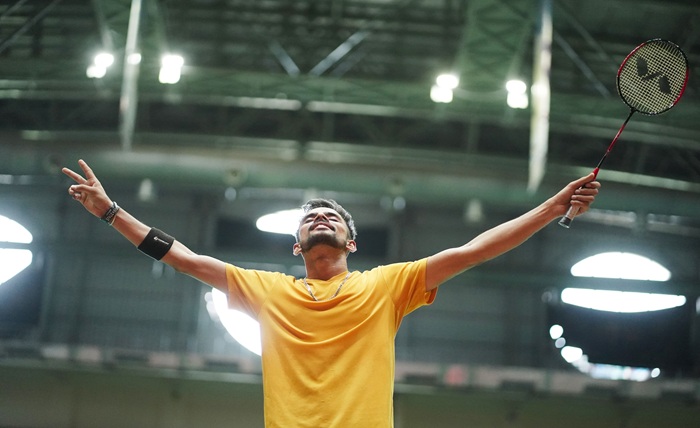
Successful men’s doubles is not simply singles played by four athletes. The court is the same size, but the tactical structure changes. Exchanges are faster, the front court becomes more important, and a pair must move as a unit. Chirag Shetty and Satwiksairaj Rankireddy have built their partnership around these demands. Their success comes from complementary roles, rotation, pressure in the first three shots, and an ability to turn small positional advantages into attacks.
Their matches can change within seconds because one interception or weak lift may alter the entire formation. That speed of transition has parallels with fast digital formats such as the lightning roulette website, but on a badminton court the outcome depends on positioning, anticipation, and coordination rather than a single moment. Shetty and Satwik succeed because they repeatedly create situations in which both players understand where the next pressure should come from.
Complementary Roles Without Fixed Positions
The simplest description of their partnership presents Satwik as the rear-court power player and Shetty as the front-court controller. There is truth in this model, but elite doubles requires more flexibility.
Satwik’s smash gives the pair a way to attack from the back. His power can force blocks, lifts, and defensive drives. Shetty can then move forward and intercept those returns before opponents recover.
However, these roles cannot remain fixed throughout a rally. Shetty must attack from the rear when rotation places him there, while Satwik needs to control the front court when the situation demands it.
The strength of the partnership is therefore not strict specialization. It is the ability to favor certain roles without becoming trapped by them.
Why the Front and Back Formation Matters
An attacking doubles pair generally wants one player in the rear court and the other closer to the net. This formation creates two layers of pressure.
The rear player attacks downward. The front player looks for the weak response.
Satwik’s power makes this structure valuable because opponents often have limited time to control his attacks. A defensive return that travels slightly too high can become an interception opportunity for Shetty.
Shetty’s task is not merely to wait near the net. He must read the defender’s racket position, predict the likely return, and decide how aggressively he can move across the front court.
If he commits too early, opponents can redirect the shuttle. If he waits too long, the defensive return may pass him and reset the rally.
The First Three Shots Shape the Rally
Serve, return, and third shot have major tactical importance in doubles. The pair that gains an attacking position during this sequence can control the next phase.
A short serve aims to prevent the receiver from attacking downward. The receiver, meanwhile, tries to take the shuttle early and create pressure. The serving pair then needs a third shot that prevents the opponents from establishing control.
Shetty and Satwik use this phase to compete for initiative rather than simply start the rally.
Flat pushes, net shots, drives, and quick interceptions become important because lifting too early can hand the opposition an attacking formation. Against strong doubles pairs, voluntarily giving away the attack can mean defending several consecutive smashes.
Their success therefore depends partly on how often they can enter the main rally from a neutral or attacking position.
Rotation Keeps the Attack Alive
Rotation is one of the least visible elements of doubles. When executed well, it appears natural. When it fails, large spaces open immediately.
After attacking from the rear, Satwik may move forward if his momentum and the opponent’s response make that transition logical. Shetty then rotates behind him to cover the rear court. Similar exchanges happen in the opposite direction.
The purpose is to maintain balance without losing pressure.
Both players must read the same tactical signals. A block toward the net may require forward movement. A lift over the front player may trigger a rotation. A flat exchange can force both players into a side-by-side structure before another opportunity appears.
This coordination reduces hesitation. At doubles speed, even a short delay can leave part of the court exposed.
Power Works Because Someone Follows It
Satwik’s smash receives attention because of its speed, but power alone does not explain the partnership’s results.
A smash becomes more effective when the attacker knows that a partner is covering likely responses. Satwik can direct an attack toward the body or between defenders with the expectation that Shetty will search for the next shuttle.
This creates a sequence rather than an isolated shot.
The first smash may not be intended to win the point. Its purpose can be to produce a short block. The next interception may force a lift. A second attack then arrives from a stronger position.
The pair can build pressure over several strokes until the defense loses control.
Defense Is Also a Transition Phase
Strong doubles teams cannot attack continuously. Shetty and Satwik also need to survive periods when opponents control the shuttle.
Their defensive objective is not only retrieval. They search for a return that changes the formation.
A high lift can reset positioning, but a flat drive can challenge the attacker immediately. A controlled block can force the rear-court player forward. If the opponents respond by lifting, the defensive pair can become the attacking pair within seconds.
This transition is crucial because doubles rallies often revolve around control of downward shots.
The pair that escapes defense first gains an opportunity to dictate the exchange.
Communication Reduces Tactical Uncertainty
Partnerships also depend on decisions that statistics rarely capture. Players must know who takes shuttles through the middle, who covers after an interception, and when a rotation has started.
Much of this communication develops through repetition.
Over time, partners learn each other’s movement patterns and preferred responses. They can anticipate where the other player will move without needing a verbal instruction during every exchange.
That familiarity allows Shetty and Satwik to play at a pace where conscious discussion would be impossible. Their positioning becomes a shared system.
The Real Secret Is the System
There is no single technical secret behind Shetty and Satwik’s doubles success. Their partnership works because several elements reinforce one another.
Satwik provides rear-court pressure. Shetty adds front-court interception and control. Both can rotate when the rally changes. Their serve-return patterns help them compete for the first attack, while their defense is designed to create opportunities to regain initiative.
Most importantly, they operate as a pair rather than two players sharing a court.
Elite doubles rewards this integration. Power without front-court support becomes predictable. Net skill without rear-court pressure has limited value. Movement without communication creates gaps.
Shetty and Satwik combine these components into one tactical structure. Their success demonstrates that doubles is not primarily about dividing the court in half. It is about two players continually reorganizing the same space, covering each other’s movement, and creating the conditions for the next attack.